“People seldom improve when they have no other model but themselves to copy after.”

“People seldom improve when they have no other model but themselves to copy after.”

– Oliver Goldsmith, writer

When I was a young boy, I loved to play tennis. Although very short in stature, I was very quick on my feet, and would often out-hustle, and out-last, my playing opponents. I was actually pretty good!

One day, I noticed that I was no longer doing so much running around and actually had opponents on the run, due to the well-placed shots I was able to hit.

I continued to play with the same people, and found myself winning almost every match. The downside of this was that my skills plateaued, or actually declined a bit, due to the lack of skilled opponents.

In today’s tennis world, I would simply be moved from a 3.5 level to a 4.0 level and my growth would likely begin again.

Exercise:

Where in your life have you reached the top ranks of performance and plateaued in your growth?

Where can you find others with superior skills and ability to help you stretch your limits and take your growth to the next level?

Quality of Life

“The quality of a person’s life is in direct proportion to their commitment to excellence, regardless of their chosen field of endeavor.”

– Vince Lombardi, American football coach

Image from www.transformation-catalysts.com

Image from www.transformation-catalysts.com

I have had the honor of coaching over 1,000 individuals over the past 19 years.

The pursuit of excellence in all areas of their lives is a common characteristic. I even named my six-month coaching program “Personal Excellence Training,” where each person gets to plan and execute their own personal excellence journey.

Exercise:

List five to ten of the most important areas of your life.

The list may include family, career, health, finances, community, faith, relationships, education, service, leadership, sports, skills, hobbies, travel, or other things.

Answer the following question for each area you listed:

What would I accomplish if I fully pursued personal excellence in this area of my life?

“A great pleasure in life is doing what people say you cannot do.”

“A great pleasure in life is doing what people say you cannot do.”

– Walter Bagehot, businessman and essayist

In your day to day life, how often do you see people being critical or diminishing others with phrases such as “That will never work,” “You can’t do that,” “Why bother trying?” “It’s too difficult,” “There’s no use in trying.”

How often do statements such as these stop you in your tracks? Perhaps instead, as is the case with this quote, they generate the thoughts of “Oh yeah?” “Yes, I can, I’ll show you.” “Your thinking just makes me want it more.”

Exercise:

Where are your colleagues at work, family members, and even people who you call friends placing their limiting beliefs on you?

What will it take to exceed these limits, achieve your objectives, and tell yourself “I knew I had it in me all along!”

“Our chief want in life is somebody who will make us do what we can.”

“Our chief want in life is somebody who will make us do what we can.”

– Ralph Waldo Emerson, leader of the Transcendentalist movement

When I begin a coaching assignment, I include a core value exercise. A high percent of the time, my clients include the values of “personal growth” and “realizing their potential” on their list.

My personal journey into the world of coaching began when I watched the 1992 Barcelona Olympic games, where there were approximately 2,000 coaches supporting 5,000 athletes. It seemed that Olympic levels of achievement were highly correlated with the support of a coach to help each individual achieve their best performance.

Exercise:

What percent of your fullest potential have you realized, professional and personally?

Who are the people in your life that encourage and stretch you to do all you can?

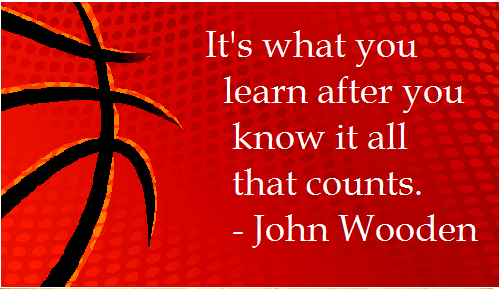
“It’s what you learn after you know it all, that counts.”

“It’s what you learn after you know it all, that counts.”

– John Wooden, basketball coach

Image of today's quote

When you hear a person say the phrase “I know,” it means that they have stopped listening. When a cup is full, it is impossible to fill it any further.

Consider the possibility that knowledge and wisdom are vital fluids that fill your life’s cup. What if the richness of life could only be held in your cupped hands? What a waste to limit yourself in this way.

Exercise:

How can you dramatically increase the size of your learning vessel, to allow greater knowledge and wisdom in?

How can you, as a scholar of life, have more of a beginner’s mind – and make your life count even more?

“Well done is better than well said.”

“Well done is better than well said.”

– Ben Franklin, one of the Founding Fathers

Do you walk your talk? Based on this quote, Ben Franklin must have spent some time in Missouri, the “show-me” state.


We have all heard the phrase that “talk is cheap” and we all know that thoughts only become things when acted upon.

Exercise:

Get out three or four brightly colored Post-it notes and write the following on each of them: What is the most important thing to do now?

Place these Post-it notes in strategic places in your world, to increase your propensity for action.

“Be more concerned about making others feel good about themselves than you are making them feel good about you.”

“Be more concerned about making others feel good about themselves than you are making them feel good about you.”

– Dan Reiland, pastor and pastor’s coach

I know of few more profound truths than this, to support both personal and professional success.

When you focus on others, show genuine interest, and let them express themselves freely, magic happens. Look for the value in their ideas and stop interrupting them to share your next brilliant thought.

It’s amazing that when people feel great about themselves in your presence, they feel a greater affinity for you as a source of this feeling.

Exercise:

Send me an email with the subject “Communication Toolbox” and I will send you a free copy of six simple and powerful techniques to take your personal and professional relationships to the next level.

Trust Yourself Test Your Limits

“To trust yourself, to test your limits. That is the courage to succeed.”

– Bernard Edmonds, writer

How often do you test your limits?

How often do you bump up against your comfort zone and stop right there in relative safety?

Is there a secret to realizing our dreams? Archimedes said that if you had a long enough lever, you could move the world.

I’d like you to consider the idea that your commitments are your levers. By using your mind to envision a better future, and then by mobilizing your strength and courage, you can move beyond your self-imposed limits.

Exercise:

List three to five of your highest-priority commitments that are essential for you to consider your life a success.

What can you do today to fulfill these commitments and exceed your limits?

“Quality is never an accident; it is always the result of high intention, sincere effort, intelligent direction and skillful execution; it represents the wise choice of many alternatives.”

“Quality is never an accident; it is always the result of high intention, sincere effort, intelligent direction and skillful execution; it represents the wise choice of many alternatives.”

– William A. Foster (attrib.)

Six Sigma, TQM and Lean Manufacturing are processes that many organizations use to build quality into their products and services. These programs, when successfully implemented, meet all the attributes of high intentionality, sincere effort, intelligent direction and skilful execution.

But what about the rest of us, who may not work in the world of manufacturing?

Exercise:

How can you apply these characteristics to build strong relationships, a rewarding career, and an outstanding life?

What wise choices will you make today and into the future to do just that?

Character is like a tree

“Character is like a tree and reputation like its shadow. The shadow is what we think of it; the tree is the real thing.”

– Abraham Lincoln, 16th President of the United States

Who are you and how do you behave when no one is watching? Are your values expressed in your deeds at all times, or only when you are on display for others to see?

Golf is a sport of great character, where the participants actually call penalties on themselves, even when their playing partners rarely, if ever, see these penalties.

Exercise:

What are your daily standards for living a life of honor and integrity? To what values do you hold true, so that you always live in this manner, regardless of whether an audience is there to observe?

What changes will you make to focus on your character, rather than your reputation?