FRIDAY REVIEW: SELF-DISCIPLINE
When and in what ways do you demonstrate discipline? Here are a few self-discipline related posts you may have missed.
“A committee of one gets things done.”

“Your ‘I Can’ is more important than your I.Q.”

When and in what ways do you demonstrate discipline? Here are a few self-discipline related posts you may have missed.
“A committee of one gets things done.”
“Your ‘I Can’ is more important than your I.Q.”

Image from Unsplash by Aron Visuals
How does today compare to yesterday, last week, last month, or last year?
To what degree have you accepted that the past is history and the future a mystery?
What did the good old days look and feel like for you? To what extent is it possible to go back and actually recapture your happiest of yesterdays?
Where do and don’t you have control or considerable influence on what tomorrow may be?
What can and will you do today that will help realize the possibilities of many better tomorrows in your personal and professional communities?
What might it cost if you wait or hesitate?

Image from Pinterest
Imagine that you are a lobster that is not on the menu of some local restaurant.
You are swimming in the ocean, doing what lobsters do.
To get to be a two pound or larger crustacean, you had to molt many times. Over the years, you broke out of your shell due to your continuous growth.
What constraining or limiting factors did you have to leave behind to reach this point?
What parts of yourself will need to grow – and what parts must be shed – to become the person you will be tomorrow?
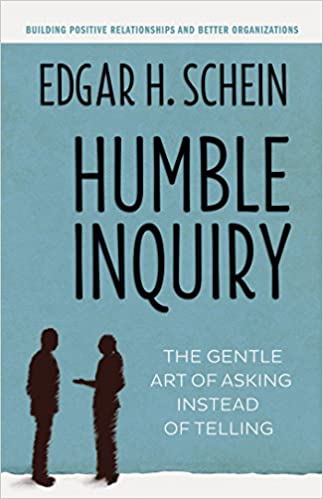
I recently reviewed Humble Inquiry by Edgar Schein. The subtitle is: The Gentle Art of Asking instead of Telling, which as a coach, had a great deal of appeal to me. Some key take-aways include:
We can all practice this important skill by slowing down, becoming more mindful and aware of our interactions and our surroundings.
Consider exploring Humble Inquiry – The Gentle Art of More Asking and Less Telling as a door to greater wisdom for yourself.

Image from Unsplash by Dan LeFebvre
In his book, Tribes, Seth Godin indicates that two critical factors of a tribe are shared interest and a way to communicate.
In the past few months, Kinsa Health has sold or given away more than a million smart thermometers that can communicate through an internet connection, to examine potential hot spots associated with the Corona virus.
Going beyond single data points to large numbers and their trends is increasingly helpful to our leaders in their ability to assess, monitor, and optimize our shared interest in the health and well-being of all people.
As a global tribe of billions, our collective commitments and our connectivity is providing a much more comprehensive set of data points to proactively react and respond to many diverse factors in real time.
We become a global thermostat when we maintain our shared interests and when we communicate.
In what ways can you and other in your personal and professional tribes use and monitor your collective thermostat to make the necessary adjustments in your communities?
What does it mean to truly understand? Here are a few understanding-related posts you may have missed.

“A point of view can be a dangerous luxury when substituted for insight and understanding.”

“Help me understand that better.”

“Look not at the vessel, but at what it contains.”

In his classic work, Meditations, Marcus Aurelius said:
If anyone can prove and show to me that I think and act in error, I will gladly change it – for I seek the truth, by which no one has ever been harmed. The one who is harmed is the one who abides in deceit and ignorance.
To what degree are you and those around you seekers of truth? To what extent do you embrace the facts – or in current terms, embrace the science – to help you make better decisions in your personal and professional activities?
Holding our thoughts up to the light of day and greater wisdom beyond our current views can help all of us come together, improve our relationships, and perhaps solve many of the challenges facing our world.
What would happen if no one was ashamed or reluctant to change their mind in the light of new information? Where and with whom would admitting you were wrong and apologizing be the right thing to do?

Image from Unsplash by Nathan Dumlao
How are you and the people in your personal and professional communities doing relative to today’s quote?
With far more time on our hands due to social and physical distancing, I’ve observed a lot of people thinking and feeling more deeply than ever before.
When – perhaps in the past – have you gone along with the crowd instead of trusting your own heart and head before making an important decision, or taking a significant action?
How has the world grinding to a halt versus the frenetic pace we usually keep given you greater clarity on life?
How can and will you use the lessons from these challenging times to help you count yourself among the “few more” people who think with their own minds and feel with their own hearts?
Please reply to this post with whatever thoughts and feelings you care to share.
 How have your personal and professional worlds changed in the past three or four months?
How did things look a year ago for you and others in your communities?
To what degree has your focus shifted from “me” to “we”?
Where have you expressed sagaciousness in your actions, and where might you feel reluctance to step forward?
Our world needs all of us, and we all need one another to address this pandemic and other local and global challenges.
How might we all use this point in time to come together to more fully and more enduringly synergize our collective efforts to realize a far better “future us”?
What actions can and will you take to move past the myopic “present you” to become the sagacious “future you”?

Image from Unsplash by Ani Kolleshi
The COVID-19 pandemic has tested all of us in may ways, personally and professionally.
Who are the individuals that stand out in your heart and mind as true leaders, taking a stand for what they value and believe?
Consider the folks at the grocery store, your mail carrier, your local banker, and other essential business professionals. How about those health care workers putting their lives on the line, leaving their homes to help those hit hardest, some even going to other states?
What about our military professionals and government officials? Who has truly stepped up? Who has side-stepped or blamed others for how things are or are not progressing?
How can and will you more fully acknowledge and recognize the acts of leadership all around you? How and in what ways have you stepped up to be seen and heard in your communities? What would be the value if all people around the globe did the same?