When we follow the messages of our heart and intuition…

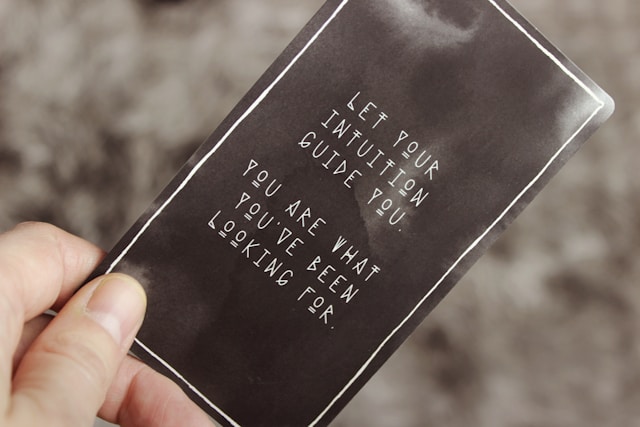
When we follow the messages of our heart and intuition, we discover a wisdom seldom available through thinking.

—Calm App Reflection

Image from Unsplash by Jen Theodore

When we follow the messages of our heart and intuition, we touch a wisdom that no amount of thinking can reach.

The mind calculates, compares, and asks questions — but the heart simply knows. It doesn’t traffic in logic or fear; it whispers truth in quiet, persistent nudges.

Too often, we drown it out with noise and analysis, choosing certainty over authenticity. Yet the deepest breakthroughs — love found, dreams pursued, peace restored — come when we trust that inner voice.

When logic runs out of answers, intuition steps in, guiding us toward what feels alive and real.

The question is: are we listening closely enough to follow where it leads?

EXERCISE:

In what ways can and will you tap into the often soft, subtle messages of your heart?

How can you apply its intuitive wisdom to offer you greater clarity without calculation to the unfolding of your life?

“Humility, that low, sweet root, from which all heavenly virtues shoot.”

“Humility, that low, sweet root, from which all heavenly virtues shoot.”

Thomas Moore, 17th Century Irish writer, poet, and lyricist

Image from Unsplash by Antonino Visalli

Humility is not a weakness — it is the quiet power for which our noisy world is striving.

Thomas Moore called it, “That low sweet root, from which every heavenly virtue shoots,” and you can see why.

In an age of selfies, personal brands, and constant “look at me,” humility invites us to step out of the spotlight and back into truth.

It doesn’t shrink your greatness; it grounds it. Humility lets you admit “I don’t know,” so you can finally learn.

It lets you say, “I was wrong,” so you can finally grow.

If you want more wisdom, patience, and compassion in your life, don’t chase them. Cultivate the root: nurture humility.

EXERCISE:

In what ways can you cultivate humility as the quiet strength that lets your wisdom, patience, and compassion grow?

Letting others have the last word, apologizing more often, asking for help, and offering more secret acts of service can be wonderful places to start!

“A loving heart is the truest wisdom.”

“A loving heart is the truest wisdom.”

Charles Dickens, 19th Century British journalist & Social Critic

Image from Unsplash by Sue Winston

In a world often rushing toward success and achievement, Dickens’ words remind us of life’s simplest, deepest truth: wisdom begins with love.

A loving heart sees beyond judgement and fear— it listens, forgives, and understands.

True wisdom isn’t measured in knowledge or status, but in the kindness we extend to others.

Every small act of compassion — a smile, a helping hand, and kind word — ripples outward, softening hearts and nurturing hope.

When we choose love, we choose connection, healing, and peace. A loving heart doesn’t just make us wiser — it makes the world gentler, one kind moment at a time.

EXERCISE:

How could you measure your success by the love you give and receive each day?

How would expressing your loving heart more often help you live a wiser and more meaningful life?

One who looks around him is intelligent

“One who looks around him is intelligent; one who looks within is wise.”

Matshona Dhliwayo — Canadian Philosopher, Entrepreneur, author

Image from Unsplash by Laurenz Kleinheider

The intelligent person studies the world around them as a keen observer of trends, systems, and human behavior.

They learn from what they see. But wisdom begins when the gaze turns inward.

To look within is to face the silent questions: What drives me? What am I resisting? Where am I not free?

Intelligence gathers information. Wisdom transforms it into understanding.

The outer world shows us how to succeed. The inner world teaches us how to live.

The balance of both creates a life not just well-informed, but deeply anchored.

So, look around to learn, but pause each day to look within to see, to listen, and grow truly wise.

EXERCISE:

Create your own list of provocative questions to pursue your inner path toward greater wisdom.

Consider discussing these questions with a friend, mentor, or coach to make even more of this inquiry.

If wisdom is understanding the long-term consequences of your actions

“If wisdom is understanding the long-term consequences of your actions, judgement is applying that wisdom to make better decisions. Judgement, in effect, is applied wisdom.”

Rohan Rajiv, Author of A Learning a Day Blog

Image from Unsplash by Kyle Glenn

Wisdom and judgement work hand-in-hand, shaping the way we live and lead.

Wisdom is more than knowledge — it’s the ability to see beyond the moment and understand the long-term consequences of our choices.

But wisdom alone is not enough.

Without judgement, it remains theory, a quiet voice never acted upon.

Judgement is wisdom in motion — the daily practice of applying insight to decisions both big and small.

It prevents us from repeating mistakes and guides us toward actions that align with our values and goals.

When we cultivate judgement, we turn awareness into impact.

True growth comes not from simply knowing what is right, but from consistently choosing to act on that wisdom.

EXERCISE:

Value check your decisions today to determine how well your choices align with you values and long-term goals.

Applying this practice daily will decidedly impact the way you live and lead.


Some of the best advice we can take

“Some of the best advice we can take is the advice we offer to others. Some of the best advice we offer to others is the advice we ourselves end up ignoring.”

Stephen St. Amant, author of the Savenwood Blog

Image from Unsplash by Jakub Żerdzicki

Have you ever noticed how easily wisdom flows when we’re helping a friend or colleague?

As a coach, I often find that my own words — shared to inspire and motivate others — are exactly what I need to hear the most. Yet, it’s all too easy to overlook our own guidance.

Why is this?

When helping others, we often see their situation with clarity and objectivity. We draw on our own experiences, values, and hard-earned wisdom to guide them, but when we’re faced with our own challenges, emotions and self-doubt can cloud our judgement.

Suddenly, the advice that seems so obvious for someone else feels impossible to apply to ourselves.

EXERCISE:

The next time you feel stuck on an important matter ask yourself: What would I tell a friend in this situation?

Chances are, the answer may be just the coaching you need and deserve.

The most certain sign of wisdom is cheerfulness.

“The most certain sign of wisdom is cheerfulness.”

Michel de Montaigne, 16th Century French Renaissance philosopher

Image from Unsplash by Allen Vinicius

Today’s quote is a reminder that true wisdom isn’t just about knowledge or intellect — it’s about maintaining a joyful and positive outlook on life.

Cheerfulness reflects an inner peace and understanding that challenges and setbacks are part of the human experience.

Wise individuals embrace life’s complexities with grace and optimism, inspiring those around them.

In today’s fast-paced world Montaigne’s words encourage us to cultivate happiness as a sign of deep wisdom, showing that a cheerful spirit can illuminate even the darkest moments.

Ultimately, wisdom and joy go hand in hand, creating a fulfilling and balanced life.

EXERCISE:

In what ways can you see cheerfulness as a sign of wisdom?

How can you find more joy in simple things and approach each day with a lighter touch?

“What gets better as we age?”

“What gets better as we age?”

—Author Unknown

Image from Unsplash by Dmitry Mashkin

In the years following my dad’s passing, I’ve developed a far greater interest in the subject of aging.

Although there are many reasons to see these years as ones of decline from our younger selves, there is still plenty of evidence that numerous areas of life tend to improve, including:

  • Happiness and Well-Being: older adults often experience greater life satisfaction and emotional stability, with reduced stress from the responsibilities of raising children and work.
  • Self Confidence: many older individuals become more comfortable in their own skin, embracing their true selves without the need for external validation.
  • Wisdom and Decision-Making: tend to improve through the accumulation of life experiences and more thoughtful informed choices.
  • Empathy and the ability to more deeply understand the emotions and experiences of others tend to improve, like a fine wine with time.

EXERCISE:

How can you see yourself as getting better — not just older — with each passing day?  How might greater mindfulness and self-awareness of the aging process help you experience a richer, more fulfilling life?

When we teach, we learn

When we teach, we learn. Honor your students. They too are sources of wisdom.

—Calm App Reflection

Image from Unsplash by Kenny Eliason

As a senior in high school, I knew teaching and being a lifelong learner was in my DNA. Throughout my adult life, every position I’ve held had a teaching and learning component.

Now in my 32nd years as a business and personal coach, I’ve come to realize and honor the great contributions that return to me like a boomerang when I do my best to support and guide others forward.

EXERCISE:

In what areas of your life do you support others as a teacher, mentor, or coach?

In what ways have your students, mentees, and “coachees” made significant contributions to your life journey?