Satisfaction equals What you Have divided by What you Want

Satisfaction = What you Have (divided by) What you Want

—Arthur C. Brooks, American social scientist, musician, and columnist
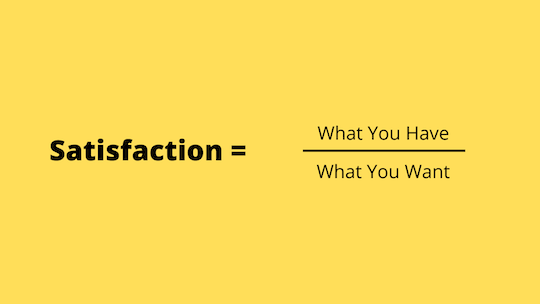
The satisfaction equation looks so simple. All we need to do is acknowledge all we have, divide it by our wants, and make sure the result is a number that puts a smile on our face when we brush our teeth before bed.

We could easily do a fast status check and feel OK, or we could do a more thorough analysis to optimize our results.  Consider digging deeper here and actually do the math.

Take two separate sheets of paper with the headings What I Have and What I Want at the top. Place these sheets in a location where you will see them throughout your day. For the next few days, jot down items on each list. Keep asking yourself What Else? before you move on to other matters.

EXERCISE:

Before you do the division problem, consider how a little addition or subtraction might increase your satisfaction.


Slow movements help slow the mind

“Slow movements help slow the mind, so it can enjoy its reunion with the body.”

—Therese Jornlin, therapist and transformational coach

Image from Unsplash by Jose Vazquez

Over the past several months, I’ve added the CALM app’s “daily move” to my morning routine. With the years adding up, I’ve found these 5-7 minute exercises helpful in soothing my creaky joints and  muscles.

Many of the movements — based on  yoga, Tai Chi, and Qi Gong — have helped me enter my day with greater energy and focus.

EXERCISE:

Where and how could you include various forms of slow movement to your day and benefit from the reunion of your mind and body?

Consider trying CALM‘s daily move for yourself and let me know what you think.

Switch up your stress story

Switch up your stress story.

—Calm App Reflection

Image from Unsplash by Elisa Ventur

To what degree do you feel like you are at a breaking point?  Where are the levels of personal and professional stress having a negative impact on your physical and mental health?

I recently visited the Corning Museum of Glass in Corning, New York. Of particular interest was a glass breaking exhibition in which various types of glass were put to the test. Over the years of use and development of this miraculous material, engineers and scientists have come up with numerous processes to make glass far stronger and resistant to breakage.

EXERCISE:

Where are you being tempered and heat treated through various life experiences? How can you view these events and the stories you tell about them as opportunities for greater growth and resilience?

Friday Review Time

Friday Review: TIME

What are your beliefs and practices relative to time? Here are a few related posts you may have missed.

“Time is the coin of your life. It is the only coin you have, and only you can determine how it will be spent.”


“Well arranged time is the surest mark of a well arranged mind.”


“If time were to take on human form, would she be your task master or freedom fighter?”


I once was better at this than I am

“I once was better at this than I am.”

Arthur C. Brooks, American social scientist, musician, and columnist

Image from Unsplash by Armand Khoury

Where are you still climbing the ladders of life? Where do you continue to learn, grow, and achieve new levels of excellence and mastery?

Where have you peaked in your personal and professional efforts? Where it is harder to keep up with your former self?

In what areas of your life have you noticed declines in physical or mental capacities, and how well are you doing navigating this descent?

EXERCISE:

Consider reading Brook’s book From Strength to Strength and pay particular attention to the concepts of fluid versus crystalized intelligence. These concepts were first described by Raymond Cattell in his 1971 book, Abilities: Structure, Growth, and Action.

I hope these resources offer you evidence and that we can all keep getting better in ways we may previously not have considered.

Good things come to those who wait

“Good things come to those who wait — and work, and sacrifice, and maybe even suffer.”

Arthur C. Brooks, American social scientist, musician, and columnist

Image from Unsplash by Levi Meir Clancy

To what degree does today’s quote resonate with you?  Consider taking a closer look into your experiences of waiting, working, sacrificing, and suffering.

How much good has come to you through these attributes? How have these aspects of life influenced your values and shaped your character?

To what extent did you recognize beforehand that much good was on the other side during these challenging times?

How, with this hindsight, can you view and experience current and future difficulties to glean the lessons and value they offer far sooner?

EXERCISE:

Where in your personal or professional worlds can you acknowledge and embrace that many of the best things in life are worth the squeeze?

Before you try to increase your willpower

“Before you try to increase your willpower, try decreasing the friction in your environment.”

James Clear, Writer, Entrepreneur and Behavior Science Expert

Image from Unsplash by Sandeep Singh

In any new coaching engagement, it is very helpful to examine the personal, social, and structural supports that are already in place.

Better outcomes are unlikely without a significant degree of motivation, ability, and willpower.

Having the social support of friends, family, and colleagues provides both encouragement and accountability.

Structural support is often trickier in that environmental cues already in place often trigger old, entrenched habits that do not serve new behaviors and better results.

EXERCISE:

Explore James Clear’s book, Atomic Habits for more ideas on this subject, and his 1-2-3 Newsletter to get you thinking differently to create better results in many areas of life.

I also recommend the book Influencer — The Power to Change Anything for other strategies to decrease the friction in our environments.

You have plenty of free time

You have plenty of free time. You just need to find where it is hiding.

—Calm App Reflection

Image from Unsplash by Annie Spratt

What if time were like an Easter egg hunt? What if you could find an extra thirty minutes — or even an hour — with each extra egg you found? Consider going on an imaginary hunt in your mind and add the extra time to your base of 24 hours. With four extra eggs you could suddenly have 26 to 28 hours to work with and navigate your days with greater wiggle room. How would you spend it?

Of course, the rotation of the earth is not going to slow down any time soon. It’s clearly up to us to become better hunters to discover where pockets of time are hiding — often in plain sight.

EXERCISE:

To determine where your actual time is being spent, consider using a time log for the next few days. You can find a copy of this exercise in my Time Management Strategies and Tactics workbook, along with other tools to help you manage your time and energy.

As you apply these tools, please also consider the filtering words More, Less, Start, and Stop as guides to reallocate this hidden resource.

Friday Review: Distractions

FRIDAY REVIEW: DISTRACTIONS

Are you easily distracted? Here are a few related quotes you may have missed.

“We wander for distraction, but we travel for fulfillment.”


“When a great moment knocks on the door of your life, it is often no louder than the beating of your heart, and it is easy to miss.”


“Lighthouses don’t go running all over an island looking for boats to save. They just stand there, shining.


“I wish getting along with people was as simple as enjoying their food.”

“I wish getting along with people was as simple as enjoying their food.”

—Valerie Bertinelli, Award-winning American actress

Image from Unsplash by Mae Mu

Consider the importance of food in your life. Chow down on this topic to examine how much it influences us beyond providing the nutrients to keep us alive.

How does food compare to the other essentials of water and air? What are the sensory experiences of each and how much pleasure and enjoyment do they offer? Food — and our rituals around it — provide us so much more than fulfilling a biologic need.

Although we sometimes find ourselves standing at the fridge eating alone, we most often seek out the company of others to deepen our bonds and create community. It is these bonds that we all need desperately to truly thrive.

EXERCISE:

When was the last time you attended a pot luck dinner where everyone brought a favorite dish to share? Consider hosting such a gathering in the coming weeks. I hope you enjoy many delicious dishes and the people that brought them!