We never do anything well

“We never do anything well till we cease to think about the manner of doing it.”

—William Hazlitt, 19th Century British Social Commentator
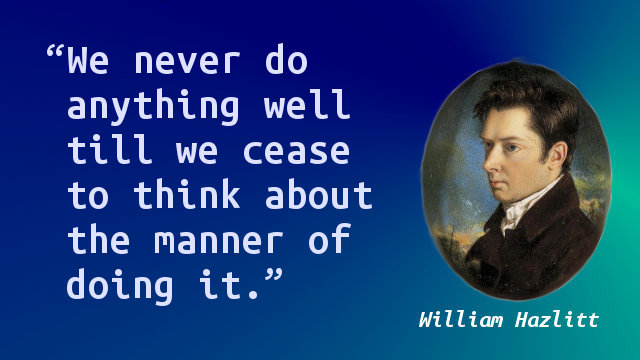
Meme of today's quoteHow many activities in the following list have you engaged in over the past year?

  • Giving a speech or major presentation
  • Writing a book or significant article for publication
  • Interviewing for a new job or promotion
  • Playing golf, poker, or a game of chess
  • Building a piece of furniture or other handy-person activity

If at least one of these activities occurred this past year, how well did you do? How competent, skilled, or masterful were you? How much effort, struggle, or ease and flow did you experience?

Hazlitt’s quote points to the fact that when we are so focused on doing things correctly we often diminish our own ability to do things well because of our preoccupation with our potential to make mistakes.

EXERCISE:

How and on what activity might a more playful approach, without much thought about doing things perfectly, help you enjoy the process and perhaps do far better than you might have imagined?

drowning in information

“We are drowning in information and starving for knowledge.”

—Rutherford D. Rogers, Deputy Librarian of Congress

Image of keyboard, hands, coffee, and watch

Image from Unsplash by Catheryn Lavery

Did you know that the average person has five social media accounts, and spends one hour and forty minutes browsing their networks each day?

The average adult also spends more than twenty hours online, and watches over thirty hours of television per week.

How does your usage compare to these statistics? To what degree are you drowning in information?

Unfortunately, many of us simply assume that is “the way things are,” and that we simply need to keep up with the pace of life and swim for our lives.

EXERCISE:

Estimate what percent of the information you take in through social media and other sources is truly valuable and worth knowing.

Begin today, through a more discerning perspective, to remove or eliminate at least one such source until your head is fully above water.

Happier Days

“Our days are happier when we give people a bit of our heart rather than a piece of our mind.”

—Ritu Ghatourey, East Indian Author

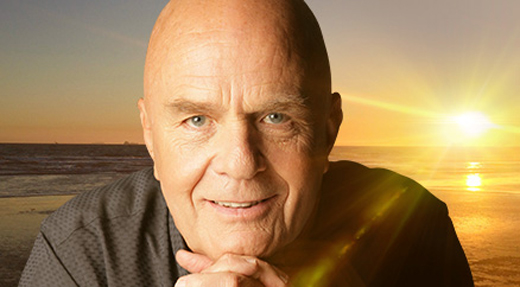
Image of Wayne Dyer

Image from Awaken.com

Wayne Dyer, who passed away on August 29, 2015, was an American philosopher, self-help author, and motivational speaker.

His life was a testament to his own journey of personal, professional, and spiritual growth. In many ways he was a true seeker of wisdom, and did more than many others in his field to pay forward his own lesson to millions of people, through various talk shows, countless speeches, and PBS specials.

One of his key teachings is that we are all connected to a divine source. By tapping into that divinity we can all live better and more richly rewarding lives.

EXERCISE:

Where and with whom would giving more of your heart instead of your mind become the source of greater happiness, and perhaps make Wayne Dyer smile in his ongoing divine journey?

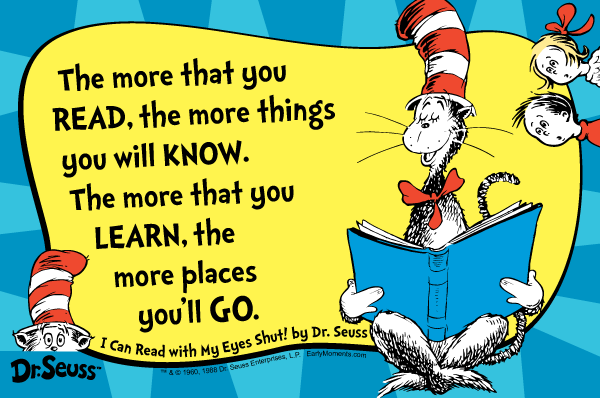
The more that you read

“The more that you read, the more things you will know. The more that you learn, the more places you’ll go.”

-Dr. Seuss, pen name of Dr. Theodor Seuss Geisel

Image of The Cat in the Hat reading today's quote

image from Dr. Suess Entrprises

Dr. Seuss really knew what he was talking about with this quote!

According to DoSomething.org:

  • 2/3 of students who cannot read proficiently by the end of fourth grade will end up in jail or on welfare.
  • One in four children in America grows up without learning how to read.
  • Students who don’t read proficiently by the third grade are four times likelier to drop out of school.
  • Nearly 85% of the juveniles who face trial in the juvenile court system are functionally illiterate, proving that there is a close relationship between illiteracy and crime.

EXERCISE:

How will you, in this new year, make a greater commitment to reading and continuous learning, to support yourself and those you care about going to more wonderful places?

FRIDAY REVIEW: ADAPTATION

Friday Review: Adaptation

The law of natural selection makes it clear: those who adapt survive. Those who don’t, don’t.  Here are a few adaption-related posts you may have missed. Click on the links to read the full messages.

“There are people whose clocks stop at a certain point in their lives.”


“The world is full of magic things, patiently waiting for our senses to grow sharper.”


“Every success story is a tale of constant adaptation, revision, and change.”


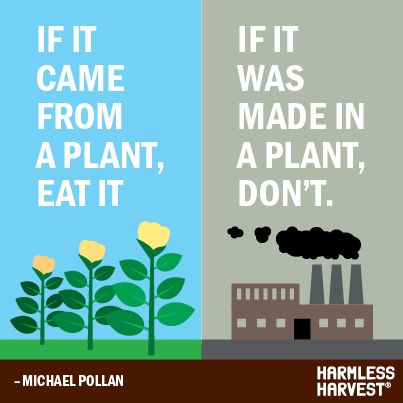
If it came from a plant, eat it

“If it came from a plant, eat it. If it was made in a plant, don’t.”

-Michael Pollan, Professor, UC Berkeley Graduate School of Journalism

Image of today's quote

Image from Harmless Harvest

A few weeks ago, at the turn of the new year, millions of people committed for the umpteenth time to live healthier lives. Among the keys to success is the focus on optimal, high-quality nutrition.

In general, the fewer ingredients on the label, the better the choice. Or, choose only those made by Mother Nature herself. A simple way to decrease poor choices is to do the majority of your shopping around the periphery of your market, and avoid the aisles full of items produced in a plant.

EXERCISE:

Consider turning your next shopping trip into a food safari. Bring more tasty, naturally grown foods into your home and body. Reducing or purging many of the packaged items already in your cupboards and fridge will reduce the chances of making poor choices.


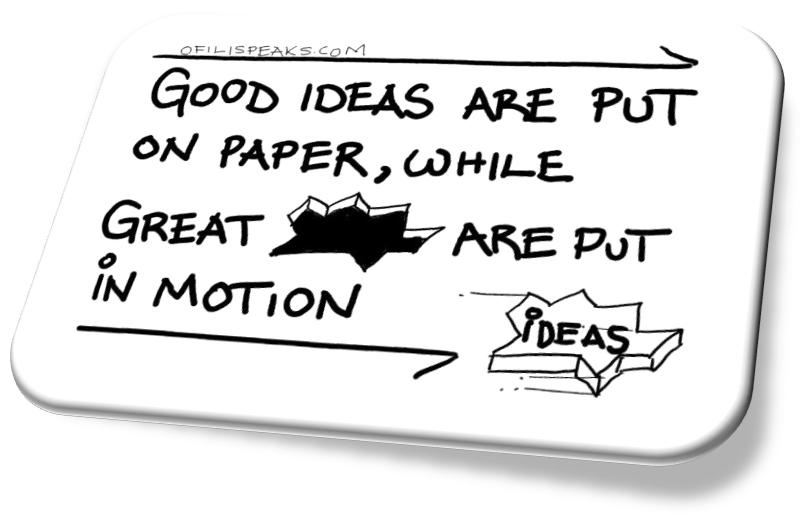
Great ideas have a very short half-life.

“Great ideas have a very short half-life.”

-John M. Shanahan, Creator of Hooked on Phonics

image of biz card with the quote on it

Image from ofilispeaks.com

When was the last time you read a book, listened to a podcast, or attended a workshop or seminar? What percent of what you learned did you retain, or better yet, put into practice?

Without going into a lot of brain science and learning theory, it is clear that if ideas are not acted upon quickly, they never make it into long-term memory, much less into tangible results.

One of my past coaching clients even named her company Info-to-Action, for just this reason.

EXERCISE:

What personal or professional idea at the top of your priority list is about to expire through inaction or procrastination? How soon will you put this info into action?

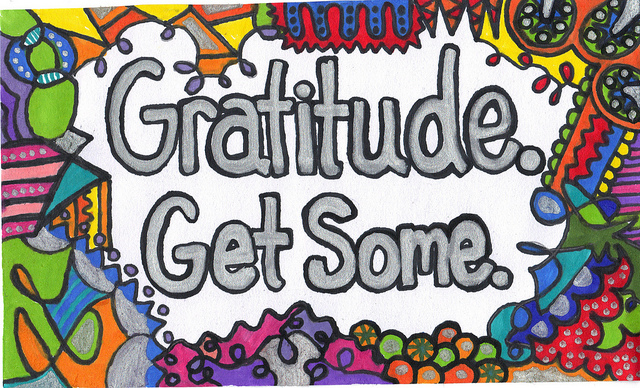
Silent Gratitude

“Silent gratitude isn’t much use to anyone.”

-Gladys Bronwyn Stern, 20th Century British Novelist

Image of poster saying "Gratitude. Get Some"

Image from Flickr by kluge

If a tree falls in the woods and there is no one to hear it, does it make a sound?

In much the same way, silent gratitude or appreciation without some form of overt acknowledgement seems to miss the mark of making any tangible impact.

In many respects, words of acknowledgement, praise, and gratitude are forms of love. They support the growth and development of enhanced relationships in many aspects of our lives.

EXERCISE:

Where and with whom will you put your silent gratitude on a loud external speaker as a foundation for improved relationships and results in your world?

Resisting Change

“One reason people resist change is because they focus on what they have to give up instead of what they have to gain.”

-Rick Godwin, Megachurch Pastor

Dice spelling "change"

Image from Flickr by Sebastien Wiertrz

Where are others in your personal or professional worlds experiencing modest, or even significant change?

Take the time to look deeply into their reasoning—on the surface, and at a deeper level.  What negative or undesirable future will come about due to the changes? What do they expect to lose as a result? What feelings and emotions are associated with such thinking? Where would greater understanding and empathy be helpful?

EXERCISE:

Where and with whom would the recognition of the potential impact of change become a first step in looking at what gains may come from the situation?

Friday Review Character

FRIDAY REVIEW: CHARACTER

How would people describe your character?  Here are a few character-related posts you may have missed. Click on the links to read the full message.

“Character is like a tree and reputation like its shadow. The shadow is what we think of it; the tree is the real thing.”


“There’s plenty of room at the top, but there’s no room to sit down.”


“Your smile is your logo. Your personality is your business card. How you leave others feeling after having an experience with you becomes your trademark.”