So removing vitamin E from its context within plant foods

“So removing vitamin E from its context within plant foods is like sending a general into battle without any troops.”

—T. Collin Campbell, American Biochemist

Image of a plate full of fresh veggies

Image from Unsplash by Anna Pelzer

One of the most interesting and valuable books I have read this year is “Whole” by T. Collin Campbell. His notoriety in the field of whole food nutrition was advanced significantly through the famous China Study. In this research, he demonstrate dramatically lower incidences of significant disease states such as cancer, heart disease, and diabetes.

A key from his more recent studies is that selecting individual or small groups of food components such as individual vitamins as a magic bullet to health is inappropriate and can even be dangerous. Optimal health, he strongly suggests, depends on a symphony of food elements interacting with our own symphony of bodily processes.

Unfortunately, telling someone to eat fruits and veggies doesn’t feed the economic engines of our medical, pharmaceutical, and food manufacturing industries.

EXERCISE:

Beyond my suggestion to read this important book how can you incorporate far more whole foods as an army to fight disease and support a longer and healthier life?


There is no greater education than one that is self-driven

“There is no greater education than one that is self-driven.”

Neil deGrasse Tyson, American Astrophysicist

Image of a notebook with a checklist

Image from Unsplash by Glenn Carstens-Peters

Elementary school, middle school, high school, and college are what we call traditional education. If you were lucky, perhaps your upbringing included books, encyclopedias, and of course, highly committed parents who emphasized education as a key doorway to a bright future.

For many, once we complete our traditional education, we slow down or even stop our efforts for continuous learning. Somehow that song, “No more teachers, no more books, no more teacher’s dirty looks” was ingrained in us, and we decided we were finished.

EXERCISE:

Consider yourself as your own home-schooling professor, creating the perfect curriculum just for you. The topics you choose are both important and relevant to a fully engaged and happy life. What could this self-driven education include that would result in a PhD in Thee?

Friday Review All About Relationships

FRIDAY REVIEW: RELATIONSHIPS

How would you describe most of your relationships? Here are a few relationship-related posts you may have missed. Click to read the full message.


“You can’t help someone get up a hill without getting closer to the top yourself.”


“Examine the contents, not the bottle.”


“You see, but you do not observe. The distinction is clear.


Tweak the balance between your dance and your march

“Tweak the balance between your dance and your march.”

—Michael Bungay Stainer, Founder of BoxofCrayons

Image from Unspash by Sarah X Sharp

What comes to mind when you consider the word dance? For me, it’s playful, fun-loving, and self-expressed.

Now what about the word march? Perhaps thoughts of the military, or simply disciplined work not necessarily of your choice come to mind.

As a young boy in grade school, the though that I could or should not play until all the work was done was prominent.

EXERCISE:

Given that for most of us the work never seems to be done, where would tweaking your own dance/march ratios make the biggest difference?

How might you bring more play to your work, or dance into a more enjoyable and productive life?

Not enough people in the world

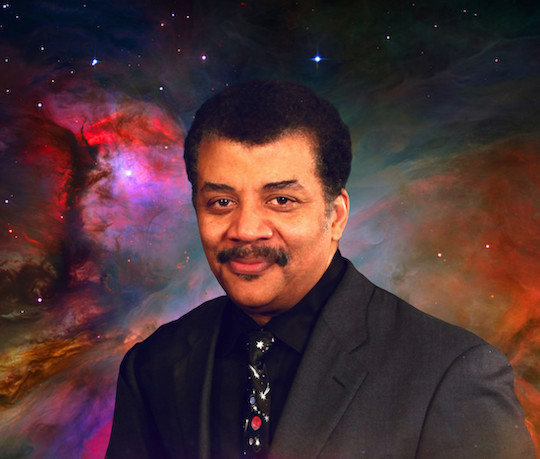
“Not enough people in the world, I think, carry a cosmic perspective with them. It could be life-changing.”

—Neil deGrasse Tyson, American Astrophysicist

Image of Neil deGrasse Tyson

Image from mountainx.com

Perhaps no single person since Carl Sagan has excited the public more about the wonders of science than Neil deGrasse Tyson. His recent work as host of Cosmos: A Space-Time Odyssey goes steps beyond Sagan’s 1980 version, Cosmos: a Personal Voyage.

Learning about how our universe works and taking a cosmic perspective has me appreciate equally my smallness and my connection to the whole of everything. This perspective has given me a passion for learning and self-development. That, in turn, has provided me much joy and satisfaction, and permits me to embrace the impermanence and the miracle of being alive.

EXERCISE:

How would taking a far more cosmic perspective of your life provide you access to living an even more extraordinary one?

Do you want to be happy

“Do you want to be happy? Let go of what’s gone, be grateful for what remains, and look forward to what is coming.”

—Author Unknown

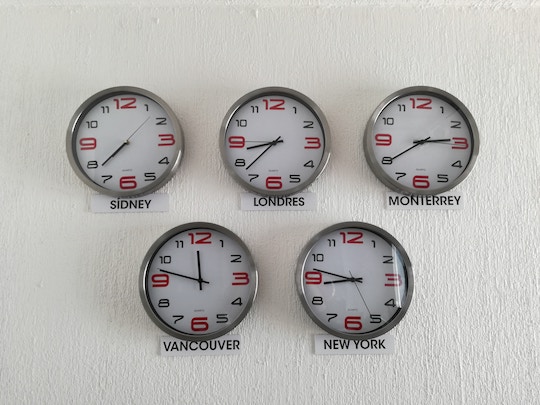
Image of five clock on a wall, showing different time zones

Image from Unsplash by Luis Cortes

Through my mindfulness efforts over the past few years, I realize that I live in three different time zones. At certain times, I reflect on the past and hold on or grasp for what seems like “the good one days.”

The bulk of my days, I try my best to remain present, in the moment, so that I can make the most of the here and now, and be grateful for all I have.

Of course, we would not be human if we did not demonstrate a healthy curiosity about the years ahead, knowing that our actions today can manifest our visions for the future.

EXERCISE:

How and in what ways can you increase your own happiness and life satisfaction by letting go of what’s gone, being grateful for what remains, and looking forward to what is coming?

The future is something which everyone reaches

“The future is something which everyone reaches at the rate of 60 minutes an hour, whatever he does, whoever he is.”

—C.S. Lewis, 20th Century British author

Image created in Canva

Today’s quote has a bit of a passive quality for me. In a recent article, Michael Simmons points out the considerable downside of a passive approach by describing a term he coined “The Five Hour Rule” a few years ago. Through his research of the most successful people in the world he discovered a pattern: They all devoted at least five hours a week to deliberate learning, to ensure long-term success.

His work demonstrates that in maintaining only our current knowledge, about 50% will become outdated within a decade. He points out that each of us will need to learn five hours a week just to stay up-to-date in our current fields, and more if we want to get ahead.

Most of us know that we all forget a significant portion of what we learn, but did you know that facts in many fields of study have a half-life where previous knowledge can no longer be found in scientific citations?

Consider where the fields of artificial intelligence, app development, social media management, driverless cars and cloud computing will be even a few years from now. None of these fields existed 15 years ago.

EXERCISE:

How and in what ways can and will you invest at least five hours each week on intentional learning?

Consider checking out Michael Simmons article by reading “The Math Behind the Five Hour Rule.”

Friday Review of Opinions

FRIDAY REVIEW: OPINION

What data or information do you use to form your opinions? Here are a few opinion-related posts you may have missed. Click to read the full message.


“Your first impression remains—but you can revise your opinion. Look once again and give someone a second chance!”


“Be careful how you interpret the world: it is like that.”


“The only way some of us exercise our minds is by jumping to conclusions.”


Don’t just go with the flow

“Don’t just go with the flow, take some dares through the rapids.”

—Author Unknown

Image of a person standing on a rickety wood bridge over rapids

Image from Unsplash by Benjamin Davies

If your life were a movie or TV show, how likely is it that it would be a blockbuster everyone talks about?

Mine would probably not be a big hit with most people. When I ask people who know me best to describe me, some words that pop up often include: dependable, disciplined, reliable, steady, cooperative, honest, loyal, and friendly.

Being a “Steady Eddie” has served me well, and I consider myself very happy with my reasonable, predictable life.

On the other hand, there are many displays in my office of my favorite quote: “When patterns are broken, new worlds will emerge.” This thought constantly reminds me to keep checking in to see where I am committed to something bigger, better, or just different from “going with the flow.” It’s at these times I periodically jump into the fast-moving or riskier waters of life, and go for it. It’s interesting to note that a high percentage of these times are associated with some of my most memorable and significant accomplishments.

EXERCISE:

What is one important area of your life in which it is time to jump into the rapids and be a bit more daring?

Questions can be like a lever

“Questions can be like a lever you use to pry open the stuck lid on a paint can.”

—Fran Peavey, late political Author

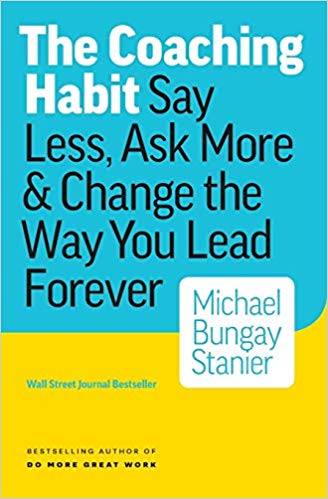
Image of The Coaching Habit book cover

Image from Amazon.com

Michael Bungay Stainer is a masterful coach whom I greatly admire. I’ve read most of his books and look forward to his daily “Great Work Provocation” blog, which you can explore for yourself at https://boxofcrayons.com/great-work-provocations-series/. His most recent work – The Coaching Habit – includes seven core questions that can help all of us pry open the lids of new possibilities in both our personal and professional worlds. I fully agree that the seven questions provided below will help us all say less, ask more, change the way we lead our lives, and better support those we wish to serve.

  1. The Kickstart Question: What’s on your mind?
  2. The AWE Question: And What Else?
  3. The Focus Question: What’s the real challenge here for you?
  4. The Foundation Question: What do you want?
  5. The Lazy Question: How can I help?
  6. The Strategic Question: If you are saying Yes to this, what are you saying No to?
  7. The Learning Question: What was most useful for you?

EXERCISE:

Please consider applying these questions to build your own coaching habit to open up your relationships and your world and lead a more vibrant and beautiful life.

You can also learn more about Michael’s books and his work at www.boxofcrayons.biz